Lake District Future – reflections 2 – What is the Purpose of the Lakes National Park?

It is a simple, but fundamental question – what is the Lake District National Park for, what should it focus on and why do we have it – a few quotes and facts that show that the question is far from simple:

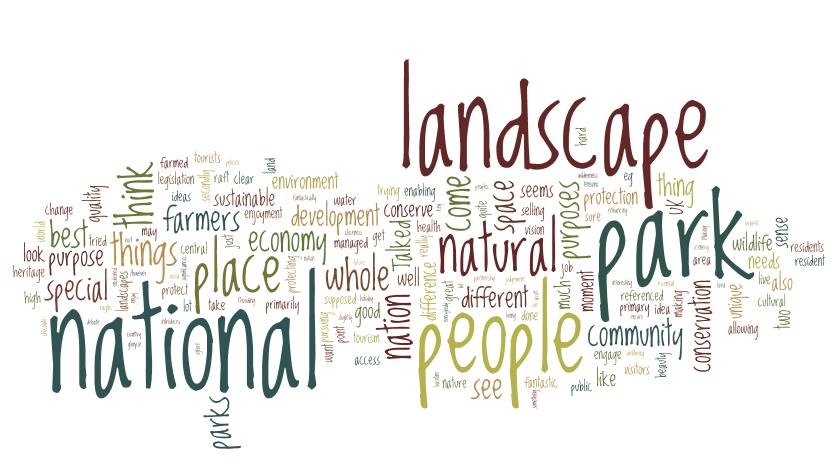
Wordcloud of interviewees answers, 'What is the main purpose of the Lake District National Park'.

Wordcloud of interviewees answers, ‘What is the main purpose of the Lake District National Park’.

So what is the main purpose of the park?

Questionnaire respondents said that the main purposes of the National Park related to protection and natural features (conservation and preservation, 60%; nature and wildlife,53%; landscape, scenery and views, 45%) with a secondary set focusing on sustainable development (sustainable economy for residents, 33%; access for recreation and enjoyment, 31%).

The quotes below from some of the interviewees demonstrates the range of different focuses and why it is far from easy to find solutions which meet all these competing needs…

  •  it’s a place people can come to get a sense of wildness,  space, the views and the terrain, the altitude and the Lakes…
  • to protect and enhance its unique cultural landscape
  • It should be about enhancing the ecological value of that piece of land…
  • It’s primarily for people – people linking with… outdoor space and… enjoy[ing] that space

So what is the Lake District about for you? Protecting the cultural heritage or developing an exciting adventure capital; supporting local residents or drawing in visitors; for wildlife or for people…

Tomorrow… is the Lakes (and should it be), wild, natural, managed… re-wilded…?

Posted in Lake District Project, The Environment | Tagged , , , , , , , | Leave a comment

Lake District Future – reflections 1 – The Lake District Now

The results of the Lake District futures research project seem to suggest our perceptions of the Lake District now, influences our choice of future scenarios for the Park.  So what do people think about the Lake District now – a few quotes and figures to get you thinking…

Positive perception of the state of the Lake District National Park

Questionnaire respondents rated ecological features and wildlife as good or very good:

  • State of ecological features – 51% rated ‘good or very good’ vs 12% ‘poor or very poor’
  • State of the wildlife – 49% rated ‘good or very good’ vs 7% ‘poor or very poor’.

Positive Reality?

This positive perception  is in contrast to the opinions of a number of the interviewees and  the impression given by the state of nature report.

“we’re really seeing all sorts of interesting, charismatic species in freefall… Particularly things like curlew, snipe, merlin …”

Rose-tinted glasses?

There was a suggestion amongst a number of respondents that there is a tendency to see the beautiful landscape of the Lakes, and see it as some kind of ‘nirvana’ where the wildlife and ecology must be in a good state…

“I think there is a perception amongst the general public that the Lakes is a wildlife oasis, which doesn’t necessarily match the reality”

“The Lake District is a devastated landscape; the high fells in particular are almost devoid of wildlife, with a severely limited biodiversity. This has resulted from chronic overgrazing by sheep… Few visitors appreciate this, or what the fells could become if managed for wildlife. Heavily subsidised sheep farming makes no sense either environmentally or economically.”

So is wildlife protection a major purpose in your view of the Lake District?  Had you always assumed the wildlife was flourishing in the Lakes?  Would you consider changes in the way the Lakes looked, if it improved the wildlife?

Tomorrow… what is the Lake District for…

Posted in Lake District Project, The Environment | Tagged , , , , | Leave a comment

Results – Lake District Futures Project

I am delighted that at the end of five months of fascinating discussions, slightly less fascinating hours battling with spreadsheets, academic articles and statistics, I have completed my project and am in the position to be able to share the results.
Questionnaire banner

Firstly, I would like to take the chance to give huge thanks to all the representatives of organisations who engaged so fully in interviews, distributed questionnaires, offered invaluable feedback throughout and showed an enthusiasm for the project which was hugely motivating for me.  I would also like to thank all the 1044 members of the public who took the time to take the survey giving real weight and statistical impact to the results and engaging passionate opinions about the future of the Lakes from people from across the country, from a wide range of professions and organisations.  Many  respondents commented that they had enjoyed doing the questionnaire because it made them think about what the Lakes meant to them for the first time.  I’ve been amazed myself, after years of living in and visiting the Lakes, that it continued, and continues to pose those questions for me and I hope that the process was as enjoyable and interesting for everyone who took part as it has been for me.

What did the project do…

The project looked at four possible scenarios for the future of the Lake District National Park:

  • Scenario A – continuation of the existing agricultural public funding and corresponding support of a status quo in Lake District land use with an emphasis on the farmed cultural landscape.
  • Scenario B – a shift in government support towards diversification, resulting in a particular focus on tourism development in the Lake District.
  • Scenario C – a reduction of government funding alongside a change in philosophy towards rewilding in the Lake District, envisaging reduced farming and a wilder landscape with the possibility of alternative industries such as wildlife re-introductions and associated tourism.
  • Scenario D – an increasing focus on land management for broader ‘eco-system services’ – for example managing the land to protect water quality and store carbon. This could involve increased tree cover and vegetation which may also aid wildlife.

You can see the full detail of the project_scenarios here.

The project had two main phases:

1 – A range of interviews with key stakeholder organisations such as the National Park Authority, the Federation of Cumbria Commoners, Natural England, Cumbria Wildlife Trust and the RSPB.

2 – A public survey carried out online and also handed out at locations around the Lakes over the summer.

What did I find out?

In its simplest terms, the results could be summarised by saying that the public seem to favour maintenance of current land use with 51% of respondents choosing Scenario A as their preferred scenario. Depending on your point of view this could be interpreted as strong support for traditional communities and landscapes, or as a status quo bias, by which people in general dislike change and want to maintain what they assume the Lakes to have ‘always been like’.  In reality there are surely elements of both.  The more interesting results of the project are, I think, the investigation of the factors which may influence the choice of scenario – ie not so much which scenario people chose, but why.

In this respect it is interesting to note that the views of stakeholder organisation did not necessarily match those seen in the general public.  It is therefore interesting to think about the different perceptions of the Lakes amongst these groups and how they may have affected which scenario people preferred.

Using a combination of statistical analysis and reviewing the statements made both in the interviews and through the questionnaires I looked at who favoured different scenarios, and why this may be case.

Scenario A:

  • This split the opinion of interviewees (5 chose it as their most preferred, 5 as their least)
  • However it was the MOST popular with questionnaire respondents
    (51% preferred, 16% least preferred)
  • It tended to be favoured by respondents who felt that the state of the ecology and wildlife in the Lakes is good, that farmers are important for food security and wildlife and that the Lakes has only changed a little over the last 200 years.
  • This is important and to an extent explains the difference between the organisations interviewed and the members of the public. The organisations who selected this as their least favoured scenario tended to be wildlife and ecology focused organisations.  They tended to feel that the state of the wildlife and ecology was not good (see State of Nature Report), and that intensive farming was a considerable contribution to that. Therefore they favoured scenarios which altered the status quo and improved the situation for wildlife and ecology.

Scenario B:

  • This scenario also showed a difference between the interviewees (who largely saw this as an accepted, important part of the Lakes’ future) and the public questionnaire respondents who voted this their least favourite scenario (38% least preferred).
  • This largely seemed to be explained because many members of the public were concerned that any increase in tourism would risk the Lakes becoming overcrowded and overly commercialised.

Scenario C:

  • The philosophy of rewilding certainly generated a considerable amount of discussion amongst both interviewees and questionnaire respondents. There was passionate support and opposition but also a growing influence of a potential role for rewilding by selective use, in certain areas.
  • However, it was largely not considered an appropriate scenario across the whole of the Lakes with stakeholder organisations considering it their least preferred and being the second least popular option amongst questionnaire respondents.
  • This was for a number of reasons but focused around negative connotations of the idea of ‘abandonment’ and support for existing landscapes and livelihoods.

Scenario D:

  • There appeared to be strong opportunities for the development of broader eco-system service focused land use.
  • It was the second most popular option both with stakeholder interviewees and with the public through the questionnaire.
  • However, some issues were seen in the difficulty of communicating the concept and explaining the potential combine ecology and wildlife benefits.

A key conclusion was that people’s opinions regarding potential future land use in the Lake District depended greatly on their perceptions of how it is now, and how it has changed over time.  Therefore, the project suggests that a key area in future will be the relative success of organisations in sharing more information and developing a greater understanding amongst the general public about the state of the wildlife, the importance of the cultural landscape, the positive and negative effects farming can have and a better understanding amongst the users of the Lake District about its past, present and potential future.

I hope that my project has done a little to help with this by getting people to think a little bit more about the landscape they see and what is important to them about the Lakes.  It certainly has done for me…

To that end I plan to publish a short series of quotes, snippets and further details from the project over the next week – if you are interested to find out more, follow the blog.  You can also find out more about the background to the project, respondents’ enthusiasm to see more trees and less sheep, what they considered the main purposes of the Lake District and further details of the results of the surveys, in the project executive_summary.  If you would like to know anything else, please do get in touch:
Go back

Your message has been sent

Warning
Warning
Warning
Warning

Warning.

Posted in Lake District Project, The Environment | Tagged , , , , , , , , , | 1 Comment

I-player stumbling

Wandering through the i-player I came across this documentary about the Honistor zip wire application first shown in October 2011. I found it really interesting and for anyone interested in the complex trade-offs and conflicting priorities facing the Lake District Planning Authority and the futures of our national parks in general, it’s well worth a watch – it’s a definite short cut to reading all 21500 words of my dissertation!

For me is was nice to have a relaxed reflection on just how fascinating these issues are, and how much I have enjoyed the project when I was getting bogged down in word counts and contents pages.  I think the results are looking fascinating and I hope will be of interest and useful to all the stakeholder organisations and the people who took part in the survey.  With the word count trimmed down and a few final bits added, the project is nearly done and I look forward to sharing the results here soon.

Posted in Lake District Project, Outdoor Adventures, The Environment | Leave a comment

Reshuffles and real politics

Most of my writing has been tied up in recent weeks with putting together early drafts of my Lakes Project.  But with a little bit of free time, I have been reflecting on the sale of Blencathra and the recent cabinet reshuffles.

No environmentally minded soul can be sad to see the back of Owen Paterson from DEFRA and cheers resounded in staff rooms across the country as Michael Gove was neatly slid away from the education department.  The key thing that seems to tie these two fallen heros together was an overwhelming arrogance which made them believe that their role was not to listen, facilitate and guide, but instead to drive through their own, pre-decided agenda at all cost and not minding who they upset or disengaged in the process.

I follow education policy less closely but Gove’s seemingly contradictory dreams of independent, free thinking schools, whilst simultaneously enforcing his own prejudice about what should and shouldn’t be taught, was driven in the face of increasing teacher opposition and disenfranchisement.  Whatever you think of his agenda, surely it must be a role of any Education Secretary to build strong relationships with teachers as, even if you believe it to be their role to drive change and challenge the status quo, any attempts to do so which lose the support of teachers and damage their morale in the way Gove did are surely doomed to failure.

This argument applies more strongly still to Owen Paterson.  Even the name of the Department for Environment, Food and Rural Affairs tells you that you are dealing with an area of complex compromise, challenging tradeoffs and unlikely bed-fellows. It is a department which, to succeed in any agenda, needs to build consensus, to seek win-wins between food security and wildlife, between climate change, the development of rural areas and the protection of traditional ways of life.  Therefore to have an environment secretary so clearly set against a green agenda can only be doomed to failure.  Paterson’s approach to the science of the badger cull and the science of climate change had already told us that this was an ‘Environment’ minister firmly set against the main stream of the modern environmental movement.  If there was any doubt about that through his time in office, his immediate actions on losing his job at DEFRA have nailed that coffin.  Clearly I have some bias against Paterson’s points of view, I do believe that climate change and broader environmental issues represent the biggest challenge facing modern governments.  I would like to see a reforming, inspirational Environment Secretary who takes on these challenges rather than hiding their head in climate scepticism.  However, I accept that anyone taking up this post will come with their own ideas, beliefs and agendas.  But what I do demand, is an Environment Secretary open to arguments from all sides of the debate, led by genuine engagements in evidence and with the ability to build consensus and find compromise, an approach which could not be more opposite from Paterson’s.


However, overall, I don’t think it is either Paterson, or Gove who come out worst from the recent reshuffle.  For me the real villain of the piece is David Cameron.  Cameron has been praised in certain quarters for his ruthless drive and political nous in removing these divisive figures prior to the upcoming election.  However, it’s precisely that ‘political nous’ that I object to most.  Can we really believe that Cameron appointed these men blind to their approaches or the agendas they were set to implement.  Can we really accept a Prime Minister who talks on the one hand of being the Greenest Government ever and yet appoints a climate skeptic Environment Secretary who sees it as his role to fight the green blob?  Even if we can believe that Cameron didn’t know what he was letting himself in for, it should have become apparent to him through Paterson’s handling of the badger cull and his increasingly climate change skeptic approach to events like the floods.  Did Cameron, seeing this, act to change the direction of DEFRA, no.  Instead he waits until the dying sessions of parliament to shuffle his pack, not out of genuine desire to change the agenda but in a cynical political reshuffle focused entirely on optics and away from substance.

Over the same period a, perhaps at times rag-tag, group of people came together to try to buy a mountain.  The Friends of Blencathra have been criticised at times throughout this process for being politically naive, for being unclear, and unsure of what they were trying to achieve and how they would do it.  I am sure that even they would agree that at times, exactly why they felt that Blencathra should be bought by the people was not entirely clear.  It certainly may not have been clear if there was any genuine danger to the mountain and how buying would provide any greater protection than that already laid down in statute.  However, they were driven by a heart-felt belief that this was a people’s space, and be it practical, philosophical or psychological, there was something powerful about people coming together to express their love of the place, and their desire for it to be protected.  So they commited to the idea, they learnt as they went, they solicited a huge public response and financial backing and they did something.  In a way, you could say the same of Gove and Paterson.  Much as I dislike many of their views, and their inability to bring people towards consensus and co-operation, they at least were driven by a vision. If this, or the efforts of the Friends of Blencathra is naivity, I would take it over the callous, political astuteness of Cameron’s reshuffle any day.

Posted in The Environment | Tagged , , , , , , , , | Leave a comment

Survey closed


I have now closed the survey and am hugely grateful to the 1044 people who took the time to complete it and share their opinions on the future of the Lakes.  I am now working on analysis of the results and look forward to sharing the results via this blog.

Posted in Lake District Project | Tagged , , , | Leave a comment

Last chance to have your say

The survey closes on Wed, so if you still haven’t had your say on the future of the Lake District… last few days so take the survey now!

Posted in Lake District Project | Leave a comment

Some great news for birds and wildlife in Lakes

Some great news for birds and wildlife in the Lakes as red kites breed in Grizedale http://ow.ly/z8g3Y

Posted in Uncategorized | Leave a comment

Questionnaire – amazing response and closing date

Just a quick post to say a huge thanks for the brilliant response I have had to the questionnaire.  I am pleased to say that the current questionnaire count stands at an amazing 815, which is absolutely great, and has already exceeded my initial hope for 500.

I want to ensure that everyone has the opportunity to offer their thoughts, so it will remain open online for another couple of weeks, with the closing date now set as Wed 23rd July.

I look forward to seeing more questionnaires coming in, and sharing the results in due course.


Posted in Lake District Project, The Environment | Tagged , , | Leave a comment

An important word, for the humble peat bog

An important word, for the humble peat bog… http://ow.ly/yS1PU

Posted in Lake District Project, The Environment | Tagged , , | Leave a comment